
ASPIDIA
Milano
Tommaso Dragani

ASPIDIA is a biotech startup based in Milan, founded to address one of the most serious contemporary environmental emergencies: water contamination by PFAS (perfluoroalkyl substances) and other persistent pollutants. The company develops advanced technologies for remediation and bioremediation, combining chemical-physical and biotechnological approaches to achieve a truly effective, sustainable, and scalable purification.
What are PFAS
PFAS are chemicals highly resistant to water, fats, and high temperatures—characteristics that make them particularly suitable for everyday products such as non-stick pans (whose PTFE coating belongs to the PFAS family), food packaging (parchment paper, greaseproof containers), cosmetics, and detergents [1]. Once dispersed, they remain in the water, soil, and air for a very long time and can accumulate in living organisms. PFAS can represent a risk to health and the environment. Today, the scientific world and governments are working to reduce their presence and seek safer solutions.
A global problem for health and the environment
According to data collected by the startup:
- there are over 17,000 PFAS-contaminated sites in Europe, already mapped as risk areas [2];
- PFAS accumulate in human blood, with potentially serious effects on immunity, carcinogenic risk, and prenatal/pediatric development [3];
- existing technologies are limited to capturing PFAS, generating hazardous waste for incineration, with high costs, energy consumption, and the production of toxic byproducts [4].
PFAS remediation is a regulatory megatrend in Europe and the United States, with increasing obligations for water utilities, manufacturing industries, and public administrations.
€100 bn/year | <2% | €1–700 M/kg | >99% |
European cost of PFAS remediation in the "emerging" scenario | of emissions covered by remediation with current technology alone | current unit cost of PFAS destruction | removal efficiency achieved by TriClean |
A recent study estimates that European remediation of long-chain legacy PFAS alone requires approximately €37 billion over twenty years, while a scenario that also includes short and ultra-short chain PFAS such as trifluoroacetic acid (TFA) brings the annual cost to €100 billion (range €52–200 bn/year), even while covering less than 2% of ongoing emissions [5].
On a global scale, removing PFAS at the rate they are emitted would exceed global GDP [6]: a fact that does not justify universal remediation, but makes the development of targeted destruction technologies with reduced unit costs urgent. Conventional technologies based on capture (activated carbons, ion exchange resins, reverse osmosis) do not eliminate the contaminant but concentrate it into waste to be incinerated or stored, with unit costs today ranging between €1 and €700 million per kg of PFAS removed depending on the sector treated [5]. It is in this industrial space that ASPIDIA operates: reducing the unit cost of destruction by one or two orders of magnitude is the goal toward which TriClean and DEHA aim.
The solution: two complementary platforms for the total destruction of PFAS
ASPIDIA works on two integrated technologies, designed to achieve complete mineralization of pollutants.
1. TriClean – Modular, scalable, and industrial removal
TriClean is a water treatment system based on a chemical-physical approach with a polishing phase, designed to:
- degrade PFAS through advanced processes;
- selectively adsorb residues;
- remove over 99% of toxic substances;
- be integrated with existing plants;
- evolve rapidly from TRL4 to TRL7 for the first field pilots.
TriClean can operate as a standalone technology or be paired with the enzymatic component to achieve complete mineralization.
2. DEHA – Next-generation enzymatic bioremediation
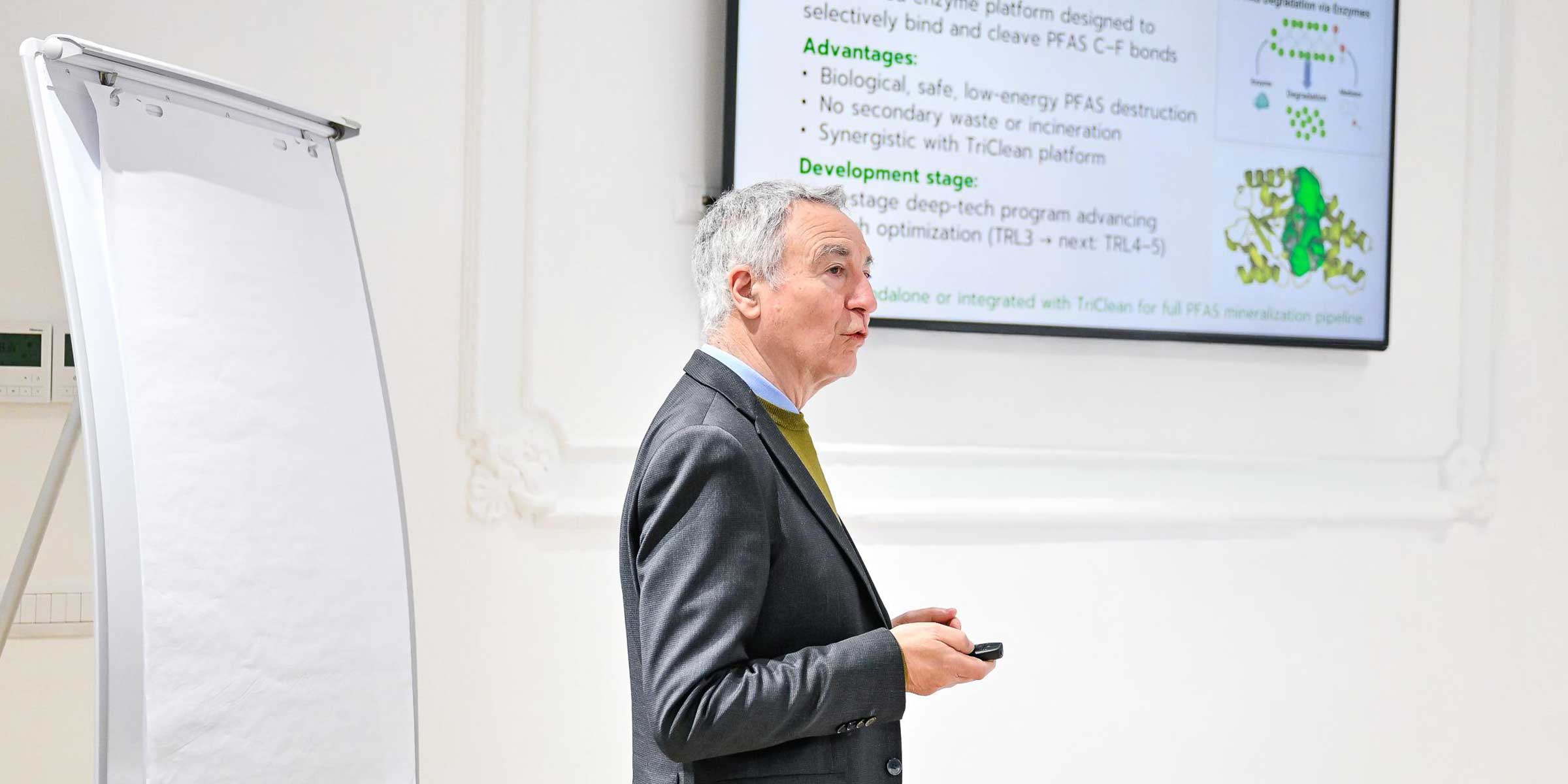
The DEHA platform is based on enzymes engineered through advanced bioinformatics and artificial intelligence, designed to:
- selectively recognize and bind PFAS molecules in aqueous matrices;
- catalyze the breaking of the carbon-fluorine bond, among the most stable in organic chemistry;
- transform PFAS into low-toxicity inorganic compounds (fluorides, $CO_2$), avoiding the generation of secondary waste for incineration or storage.
The approach is biological, low energy-consuming, and compatible with the upstream integration of chemical-physical destruction systems like TriClean. The platform is currently at TRL 3 (experimental proof of concept in the laboratory), with five candidate enzymes selected within the CHEDIH project (Circular Health European Digital Innovation Hub), in collaboration with the University of Turin.
The Team
ASPIDIA is led by a team that combines scientific, industrial, and legal expertise:
- Tommaso A. Dragani – Founder & CEO. Toxicologist and molecular epidemiologist, former director of a research unit at the National Cancer Institute of Milan. Author of 197 peer-reviewed publications (H-index 48, Google Scholar), with research periods at Columbia University and the National Cancer Center in Tokyo;
- V. Roberto Dragani – Co-founder & COO. Legal and operational manager; PhD in Corporate Law and experience in SME management;
- Cristina Dragani – Co-founder & Head of Scientific Communication. Pharmacist (MPharm), specialized in scientific dissemination;
- Marina Prisciandaro – Full Professor, Chemical Plants, University of L'Aquila: scientific lead for the development and optimization of the TriClean system;
- Francesca Spyrakis – Full Professor, Pharmaceutical Chemistry, University of Turin: computational design of DEHA enzymes.
Mission
ASPIDIA develops PFAS destruction technologies that are scientifically rigorous, industrially scalable, and economically sustainable, to subtract from environmental persistence a class of molecules that, with current technology, cannot be removed from the environment in a way compatible with global economic resources. The company operates in the space between advanced academic research and industrial remediation needs, with the objective of reducing the unit cost of PFAS destruction by an order of magnitude compared to conventional capture-based technologies.
Why now
EU Drinking Water Directive in force from 2026. REACH restrictions on long-chain PFAS operative. USA Bipartisan Infrastructure Law: $10 billion allocated for PFAS removal from drinking water. The market window is opening now.
Stage / Next milestone
Stage: post-Seed (LaGemma Venture, 2025). Round opening for: (i) industrial prototype development of TriClean with the University of L'Aquila; (ii) enzymatic bioremediation columns with the University of Turin..
Bibliographic references
[1] Spyrakis F, Dragani TA. The EU's Per- and Polyfluoroalkyl Substances (PFAS) Ban: A Case of Policy over Science. Toxics. 2023;11(9):721. Published 2023 Aug 22. doi:10.3390/toxics11090721
[2] Cordner A, Brown P, Cousins IT, et al. PFAS Contamination in Europe: Generating Knowledge and Mapping Known and Likely Contamination with "Expert-Reviewed" Journalism. Environ Sci Technol. 2024;58(15):6616-6627. doi:10.1021/acs.est.3c09746
[3] Ehrlich V, Bil W, Vandebriel R, et al. Consideration of pathways for immunotoxicity of per- and polyfluoroalkyl substances (PFAS). Environ Health. 2023;22(1):19. Published 2023 Feb 22. doi:10.1186/s12940-022-00958-5
[4] Ezeorba TPC, Okeke ES, Nwankwo CE, et al. Emerging eco-friendly technologies for remediation of Per- and poly-fluoroalkyl substances (PFAS) in water and wastewater: A pathway to environmental sustainability. Chemosphere. 2024;364:143168. doi:10.1016/j.chemosphere.2024.143168
[5] Ling AL, Aubert R, Bersi E, et al. PFAS Remediation Across Europe: Costs and Limited Impacts. ChemRxiv. 22 January 2026. DOI: https://doi.org/10.26434/chemrxiv.10001503/v1
[6] Ling AL. Estimated scale of costs to remove PFAS from the environment at current emission rates. Sci Total Environ. 2024;918:170647. doi:10.1016/j.scitotenv.2024.170647