Aspidia
Milano
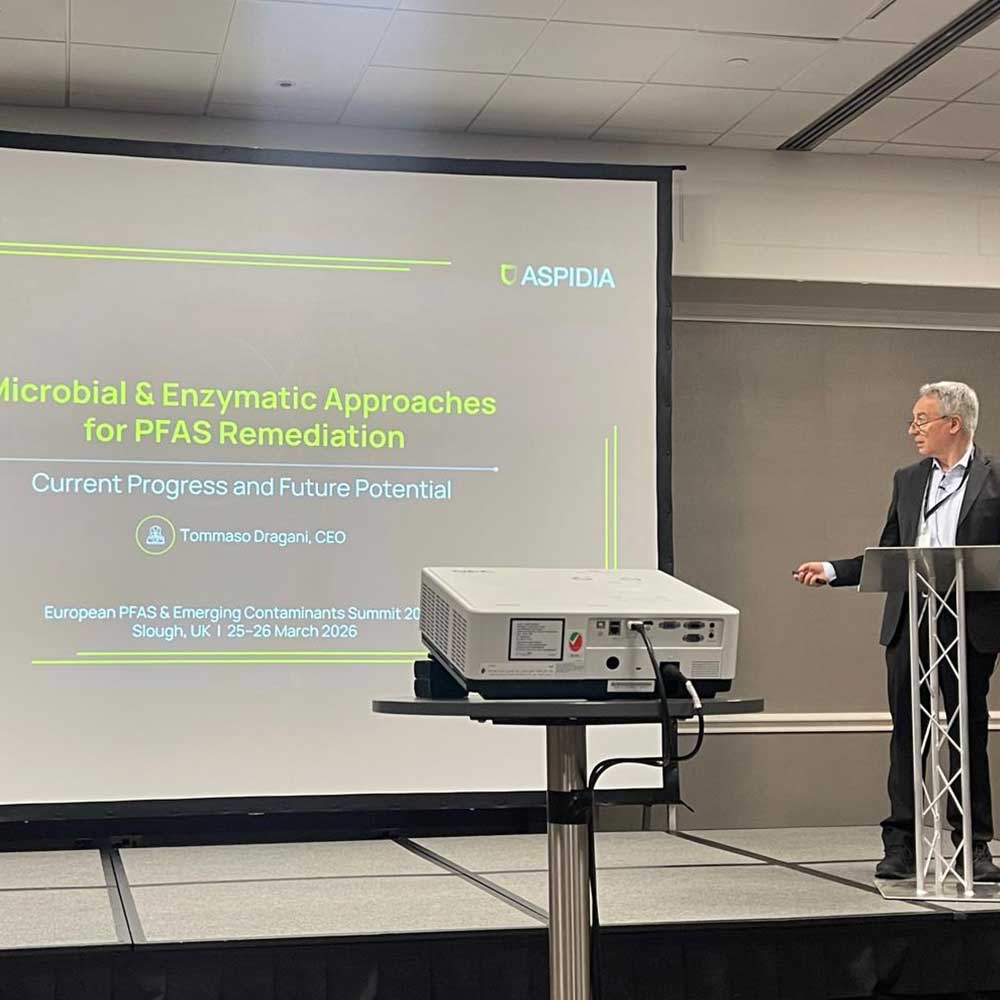
Tommaso Dragani
Short Description
The Problem: The Persistent Crisis of Forever Chemicals
PFAS contaminate over 17,000 sites across Europe, bioaccumulating in human tissue and ecosystems, and are directly linked to oncological diseases, immune system damage, and developmental disorders. Current market solutions are limited to capturing PFAS and transferring them to incineration plants—a process that is highly cost-prohibitive, energy-intensive, and fundamentally fails to provide a permanent resolution.
Business & Revenue Model
Target Market & Regulatory Drivers
- Ideal Customer Profile (ICP): Industrial operators legally mandated to treat PFAS-contaminated water. Primary verticals: drinking water treatment plants, refineries, textile and tanning industries, fluorinated material manufacturers.
- Geographical Focus: Central-Northern Europe (Germany, Netherlands, Belgium, Italy).
- Willingness to Pay: Structural and compliance-driven, unlocked by the EU Drinking Water Directive (effective January 2026).
Three-Tiered Revenue Model
- Tier 1: Co-funded Pilots
- €80K – €150K per installation
- Generates traction and technology lock-in
- Tier 2: TriClean Licensing
- €30K – €80K annual fee per plant
- Multi-year recurring contracts
- Tier 3: Volume-Based Royalties
- €0.10 – €0.30 per m³ treated
- Recurring revenue proportional to client growth
- Expected Gross Margins: >70% on licensing, >85% on royalties.
Operations & Commercial Strategy
- Asset-Light Execution: Zero CAPEX for plant manufacturing. Deployment is executed through external EPC (Engineering, Procurement, Construction) partners.
- Primary Sales Channel: Direct B2B sales.
- Strategic Partners: Environmental engineering firms and water utilities.
- Regulatory Scalability: Every new compliance standard automatically unlocks a new addressable market.
Traction
- Current Phase: Technology development and scientific validation.
- First Pilot Launch: Expected by the end of 2026.
- Technical Traction: PFAS degradation successfully confirmed in laboratory settings.
- Measurement & Quantification System: Fully operational.
- Tech Stack Progress:
- Active PFAS-degrading enzyme class identified.
- First in-silico engineered enzyme variants ready for experimental testing.
- TriClean: Currently at TRL 4 (Technology Readiness Level 4) and advancing.
- Intellectual Property: Patenting phase ongoing in collaboration with the University of L’Aquila.
- Funding to Date: €110K pre-seed investment from LaGemma Venture.
- Active Academic Partners: University of L’Aquila, University of Turin, University of Milano-Bicocca.
- Regulatory Catalyst: The entry into force of the EU Drinking Water Directive (DWD) accelerates commercial discussions with industrial operators in Italy.
Product & Development Roadmap
Phase 1 — 2026-2027
TriClean Stack
- Validation on real-world PFAS mixtures in laboratory settings
- Advancing TRL (Technology Readiness Level) from 4 to 5
- Filing of international PCT patent
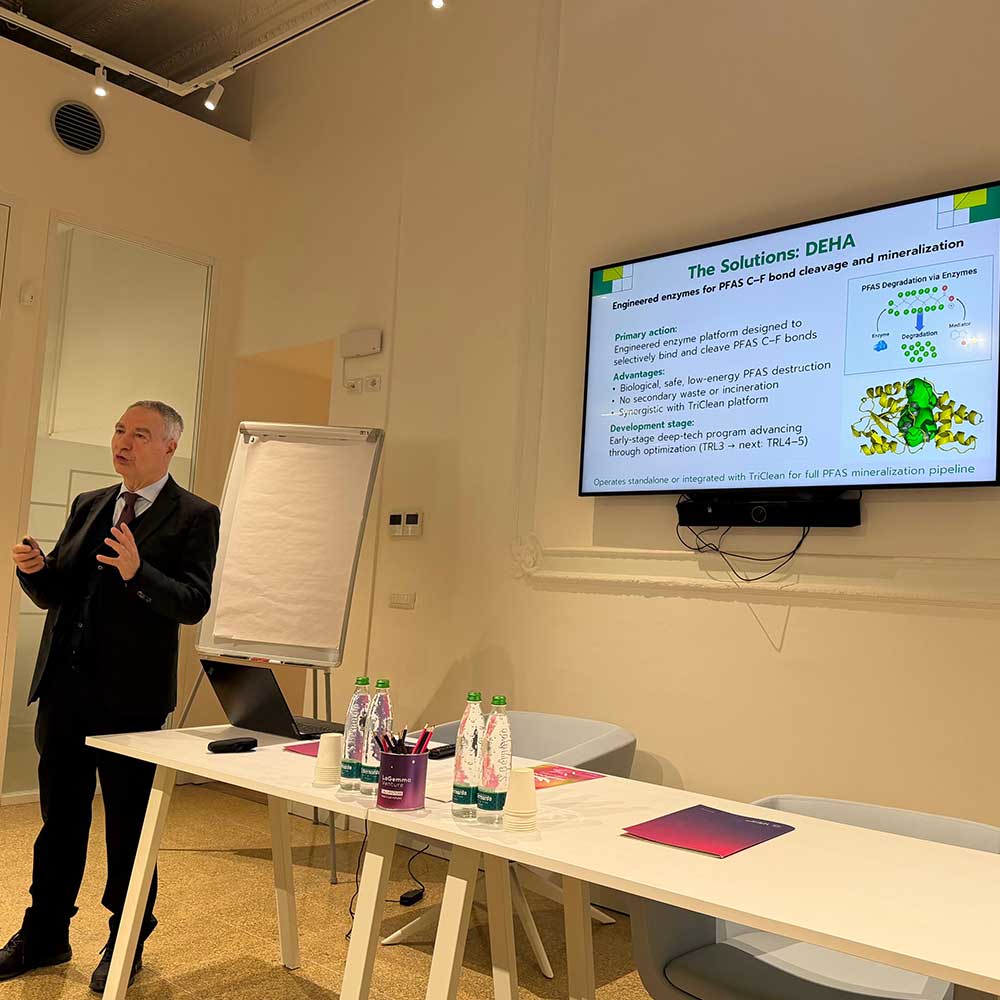
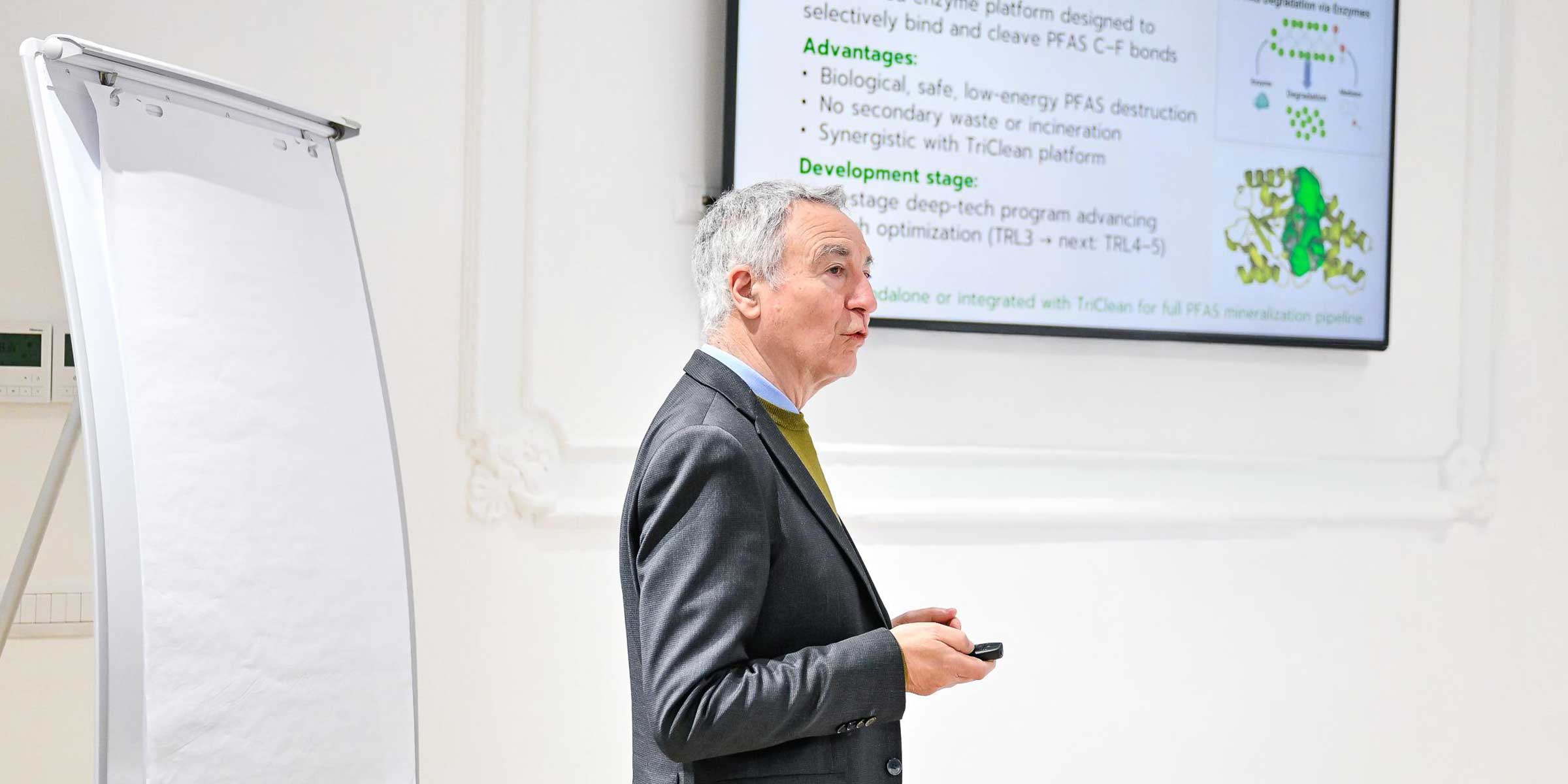
DEHA Project
- Identification and synthesis of the first candidate enzyme variants
- Advancing TRL (Technology Readiness Level) from 3 to 4
- Launch of in-vitro activity testing (experimental phase)
Phase 2 — 2027-2028
TriClean Stack
- Prototype construction and testing in a simulated real-world environment
- Advancing TRL (Technology Readiness Level) from 5 to 6
- Securing the first co-development agreement with an industrial operator
DEHA Project
- Enzyme validation under relevant laboratory conditions
- Advancing TRL (Technology Readiness Level) from 4 to 5
- Launch of bioremediation column development
Phase 3 — 2028-2029
TriClean Stack
- Prototype testing at an operational field site
- Advancing TRL (Technology Readiness Level) from 6 to 7
- Launch of the official certification process
- Initiation of the first commercial licensing negotiations
DEHA Project
- Advancing TRL (Technology Readiness Level) from 5 to 6
- First conceptual tech-stack integration with TriClean
Funding need & use of funds
Target Round Size: €500K
Lead Investor: LaGemma Venture (previously invested €110K)
Use of funds (18-Month Horizon):
- 60% (€ 300K) — TriClean Pilot: prototype construction, validation on real-world PFAS, advancing TRL 4→5
- 15% (€ 75K) — DEHA: synthesis of first enzyme variants, in-vitro activity testing, advancing TRL 3→4
- 15% (€ 75K) — Regulatory & QA: certification process, LC-MS analysis, regulatory compliance
- 10% (€ 50K) — IP & Business Development: PCT patent filing, industrial partner outreach
Team & Cap Table
Cap table:
6 %
Tommaso Dragani
47 %
V. Roberto Dragani
47 %
Cristina O.A. Dragani
Team:
The team combines high-profile scientific expertise with operational and legal experience.
- Tommaso A. Dragani – CEO, Founder. Toxicologist and epidemiologist, former Head of the Cancer Research Unit at the National Cancer Institute of Milan. 197 peer-reviewed publications, H-index: 48. Former Visiting Scientist at Columbia University and the National Cancer Center in Tokyo. Leads scientific strategy and institutional relations.
- V. Roberto Dragani – COO/CFO. PhD in Corporate Law (Bocconi University). Manages operations, administration, and legal representation.
- Cristina Dragani – CMO. Pharmacist and expert in scientific communication. Founder of Eneksia. Manages science dissemination and stakeholder engagement.
Scientific Advisors:
- Prof.ssa Marina Prisciandaro (Università dell’Aquila) – Head of TriClean Development
- Prof.ssa Francesca Spyrakis (Università di Torino) – Computational design of DEHA enzymes, active PNRR grant
- Prof.ssa Valentina Innocenzi (Università dell’Aquila) – Cavitation and environmental engineering
Environmental & Social Impact
Problem: PFAS are permanent contaminants: they do not degrade in nature, but accumulate in organisms and the food chain. Over 17,000 contaminated sites in Europe, detectable concentrations in the blood of nearly the entire adult population, and a documented association with cancer, immune dysfunction, and reproductive toxicity. The health and environmental cost is irreversible: every year of inaction worsens the damage that cannot be reversed.
Impact:
- Physical destruction of PFAS, not their displacement
- Mass of PFAS destroyed per cubic meter treated
- Reduction in concentration in the water bodies served
- Inorganic fluoride as an analytical proxy for complete mineralization
- Alignment with SDG 3 (good health), SDG 6 (clean water), SDG 9 (industry, innovation, and infrastructure)
- Compliance with the Drinking Water Directive (January 2026)
- Response to ECHA’s PFAS agenda
- Benefits for water operators, local communities exposed to contaminated sites, and regulators
- Translated with DeepL.com (free version)
Financial Structure (equity, debt, grant)
Equity:
- € 110K – LaGemma Venture (SAFE circa 9%)
Grant:
- € 3,5K – Fondazione Giordano Dell’Amore / Cariplo Factory
- € 20K – PNRR per ricerca enzimatica DEHA (erogato all’Università di Torino)
Debt:
- None